Stage 1
Select one decision or operational queue with an evidenced cross-system problem.
Integration and data orchestration
Spectra is a product direction for connecting systems and making operational data more useful at the point a team needs to act. It is not positioned as a universal data platform or a promise that every system can be integrated. The direction starts with a narrower question: where does a workflow lose context because relevant information is divided between systems, and what is the smallest dependable connection that would make that work clearer?
Product direction. Scope, maturity, availability, deployment model and fit are confirmed for each enquiry.
Discuss Spectra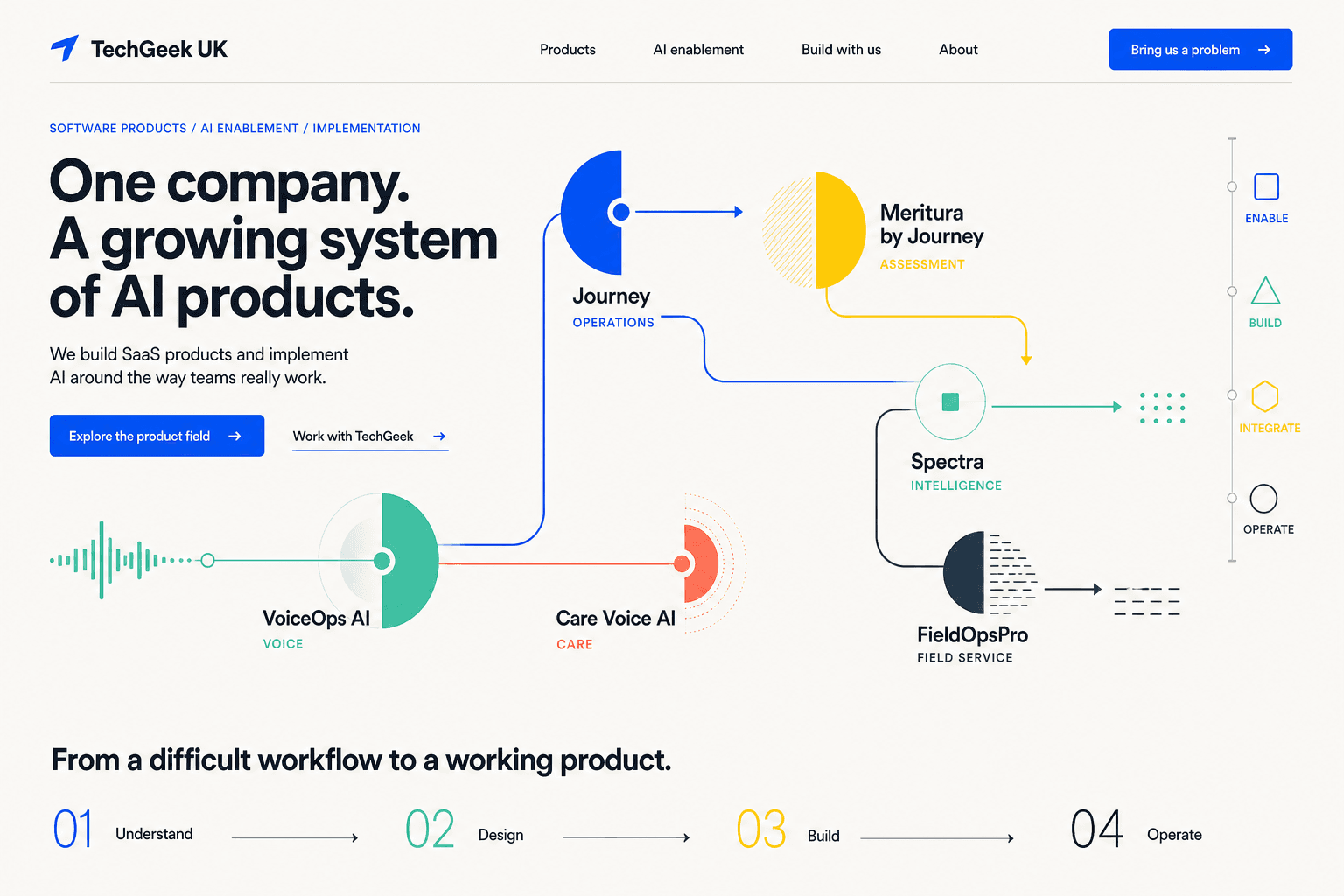
This public page describes a product direction, not an off-the-shelf capability promise. We first examine the workflow, users, system boundaries, current maturity and evidence required for a useful evaluation.
Audience and operating context
Spectra is intended for operations, product, data and delivery teams that have a real cross-system decision to make. Typical interest begins when staff manually reconcile status, copy information between tools, chase updates across teams or cannot explain which system should be believed. It is for an accountable owner who can identify a workflow and the source systems around it, not for a generic wish to centralise all data.
Integration initiatives often start with a diagram of all systems and end with a large, hard-to-govern programme. The immediate problem may be smaller: an operational queue lacks the status held in another system; a decision cannot be checked without comparing records; or a team cannot tell when data changed and who owns it. Spectra explores an integration and orchestration layer that puts a defined operational question first, then makes source, timing and exception handling visible.
Workflow before feature list
An operational owner identifies a work item whose next decision depends on status from more than one system. The team defines which source is authoritative for each field, what event or refresh makes the information useful, and what should happen when the sources disagree. A user sees a focused combined view or a routed exception rather than a silent overwrite. The design is successful only if ownership and data lineage become clearer; a new screen that hides disagreement is not useful orchestration.
Architecture decisions
Which systems and fields are relevant to the one workflow being improved?
Which source is authoritative, how fresh must the data be, and what happens when values disagree?
Are read-only visibility, controlled write-back, exports or event notifications actually required?
What API, supplier, security, consent, residency and retention constraints limit the design?
Control and assurance
Who approves a new data flow, mapping or write action?
How will users recognise stale, missing, conflicting or failed data?
What logging, reconciliation and recovery are needed for the operational risk?
Which user roles can view, correct, retry or override an integration outcome?
Evaluation
Does the chosen workflow require less manual reconciliation while preserving source ownership?
Can a user identify the source and freshness of information used for a decision?
Are data conflicts and failures visible to a person who can resolve them?
Is the integration bounded enough to support and explain after the initial delivery?
Implementation route
Select one decision or operational queue with an evidenced cross-system problem.
Document source ownership, field-level needs, timing, permissions, exceptions and acceptance criteria.
Prototype or build the smallest dependable connection, including observable failure behaviour.
Evaluate the workflow with its owners before expanding to further sources or automation.
What can be inspected now
The public record distinguishes product work that can be inspected from capability, availability or outcome claims that still need project-specific evidence.
Spectra is publicly described by TechGeek as a product direction for integration and data orchestration.
The public product-system graphic presents Spectra as an intelligence node; it is not evidence of a particular connector, data model or live implementation.
TechGeek’s public AI-development material sets out that integration, operating responsibility and evaluation are product decisions, not automatic consequences of using AI.
No public connector catalogue, deployment reference, client result or availability commitment is currently published for Spectra.
The public product-system illustration should not be read as a technical architecture diagram or a representation of a customer estate.
Data orchestration can increase risk if source ownership and exception handling are unclear; no integration should be inferred from the marketing description.
Direct answers
The site describes a product direction. Current availability, supported scope and deployment approach are confirmed against the specific systems and workflow in an enquiry.
No. Feasibility depends on the systems, permissions, interfaces, data rights, security constraints and the operational purpose of the connection.
That is an architectural and governance decision. The preferred outcome may be clearer visibility of several authoritative sources rather than a new copy of every record.
Any automation must be defined per decision, with explicit inputs, limits, human review, exception handling and evaluation. It is not assumed by the product direction.
Start with one high-friction workflow and identify the particular reconciliation, delay or uncertainty it creates. That gives a practical basis for a data and integration assessment.
Only the public product-direction description and system illustration are available. They do not establish customer usage, integrations or performance outcomes.
A practical next step
Bring the workflow, users, source systems, constraints and the evidence a first evaluation must create. We will confirm current capability, availability and the appropriate next step before proposing a delivery route.
Start a product conversation