One product question
A seven-day target is most useful where one user group needs one workflow proven. It is not a substitute for a broad product roadmap, a full platform migration or open-ended discovery.
For a tightly bounded, technically feasible brief, we can target a working MVP in as little as seven days—built to answer the most important product question.
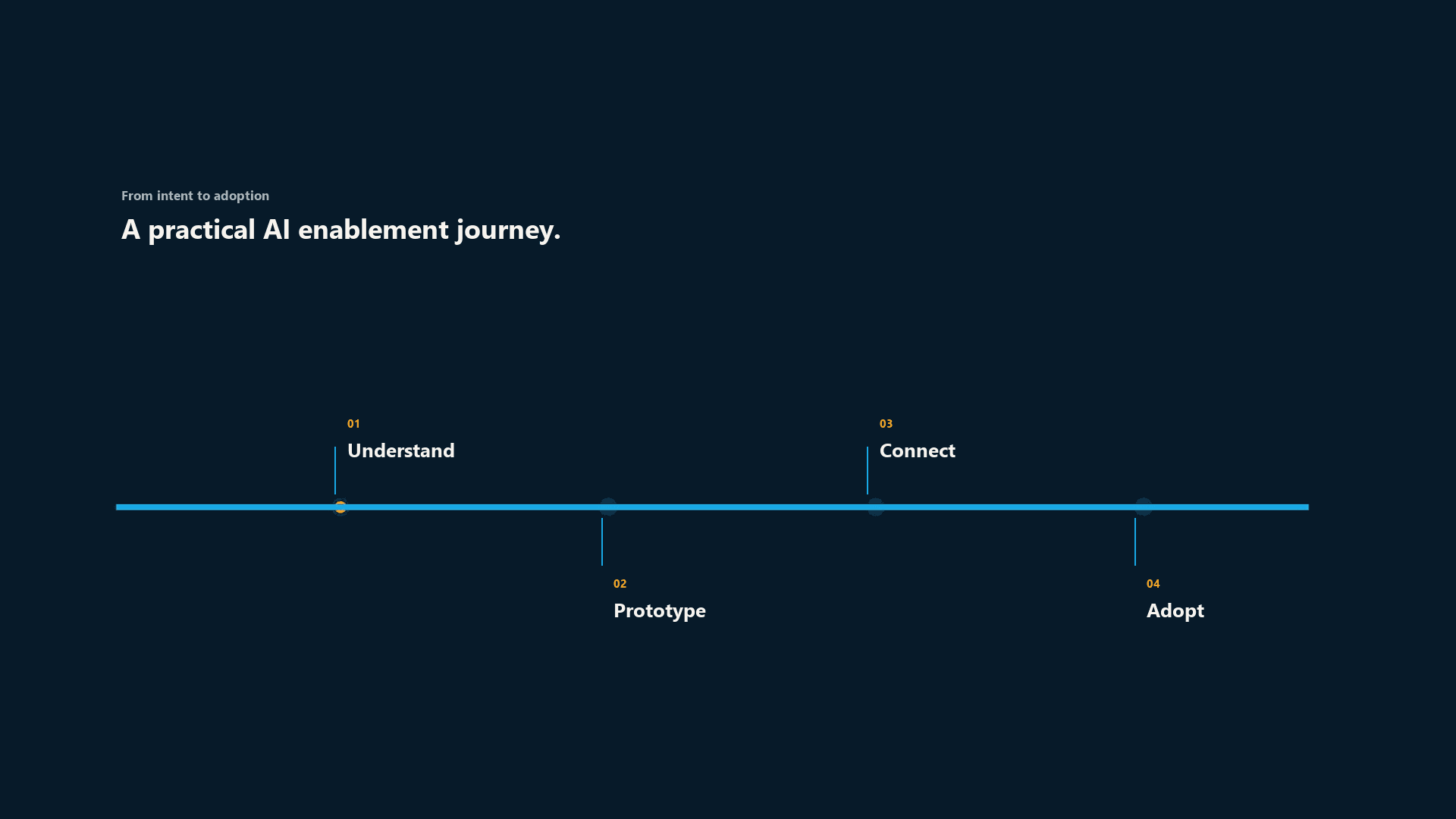
We reduce the brief to one valuable workflow, agree the evidence it must create and build the shortest dependable path through interface, model and integration.
A seven-day target is most useful where one user group needs one workflow proven. It is not a substitute for a broad product roadmap, a full platform migration or open-ended discovery.
The model, data sample, integration route and decision-maker should be available at the start. Missing credentials or unclear data rights are delivery risks, not details to solve later.
The MVP must have a named success condition: a workflow completed by a pilot user, an integration response checked, or an evaluation threshold reviewed by an owner.
A tightly bounded scope, technical feasibility, available systems and data, prompt decisions, a dedicated team and an agreed budget. Dates are confirmed only after those conditions are assessed.
No. It should be the smallest dependable product that answers the decisive question. The scope may be deliberately narrow, but the workflow, ownership and limitations still need to be explicit.
The evidence from the release informs a pilot recommendation, further discovery, a planned build or an honest decision not to proceed. The next step is not assumed in advance.
Situation signals
The organisation needs evidence about one valuable AI workflow before committing to a broader product roadmap.
A feature list is growing faster than the team can decide what must be proven first.
A model demonstration exists, but the user, input, decision, interface and acceptance condition are not yet connected.
Workstreams
A rapid MVP starts with the decision the release must inform, not a generic ambition to add AI. We identify one user group, the trigger, the input, the useful output and what an owner will decide after seeing evidence. Explicit exclusions protect the short delivery window.
The workflow includes the interface, model or rules, data boundary, integration assumptions, exception path and human responsibility. The result may be small, but it should show where uncertainty appears and what a user can do when the output is incomplete, wrong or unavailable.
Acceptance can include workflow completion, relevance checks, representative test cases, response time, integration behaviour or a pilot-user review. The appropriate evidence depends on the workload. We avoid presenting a few selected outputs as proof that a product is ready for broad operational use.
The MVP is a deliberate point of learning. It should leave a record of assumptions, exclusions, observed limitations, costs or dependencies worth investigating, and a recommendation for controlled pilot, iteration, broader discovery or stopping. The next stage is earned by evidence rather than implied by the word MVP.
Decisions and acceptance
The single workflow and user group that justify the first release.
Whether supplied data, access and integration assumptions are sufficient for a safe build.
What evaluation evidence is credible enough for the next product decision.
What is explicitly outside the MVP and cannot be inferred from it.
An agreed scope and exclusion list.
A working path that a named stakeholder can inspect using authorised inputs.
Evaluation notes and a decision meeting or owner for the post-MVP route.
Inputs and sequence
A product owner able to make timely scope decisions. Representative, authorised inputs and known data or supplier constraints. Access to the smallest viable integration, brand or interface context where relevant.
Qualify feasibility and agree the product question. Build and review the narrow workflow against explicit conditions. Use the evidence to choose controlled pilot, further work or a stop decision.
Risks and limits
A seven-day MVP is only targeted for a qualifying, tightly bounded brief with scope, feasibility, access, timely decisions, dedicated capacity and budget in place.
An MVP does not establish universal performance, compliance, security or market fit.
Missing credentials, unclear data rights or a broad multi-role workflow may change the route or date.
Direct answers
For a qualifying brief, an MVP can be targeted in as little as seven days. Scope, technical feasibility, systems and data access, decision-maker availability, dedicated delivery capacity and budget are assessed before dates are confirmed.
Sometimes. The decision depends on authorised access, the supplier interface, safety of the data path, available environments and whether the integration is necessary to answer the first product question.
Enough for the intended user to understand and test the workflow. Visual refinement should not displace acceptance, exception handling or the operating decision the MVP exists to inform.
A named client owner should review the evidence and choose the next step. Handover can document the repository, assumptions, configuration and limits, but ownership must be agreed for the particular engagement.
Tell us what must move, by when, and what access is available. We will assess fit before presenting a timeline.
Discuss the delivery