There is a real operating problem
Transformation work starts from waiting, repeated judgement, fragmented information or constrained capacity—not a generic request to use AI somewhere in the organisation.
We find where AI can earn its place in real work, then deliver the roadmap, focused pilot and adoption path needed to make it useful.
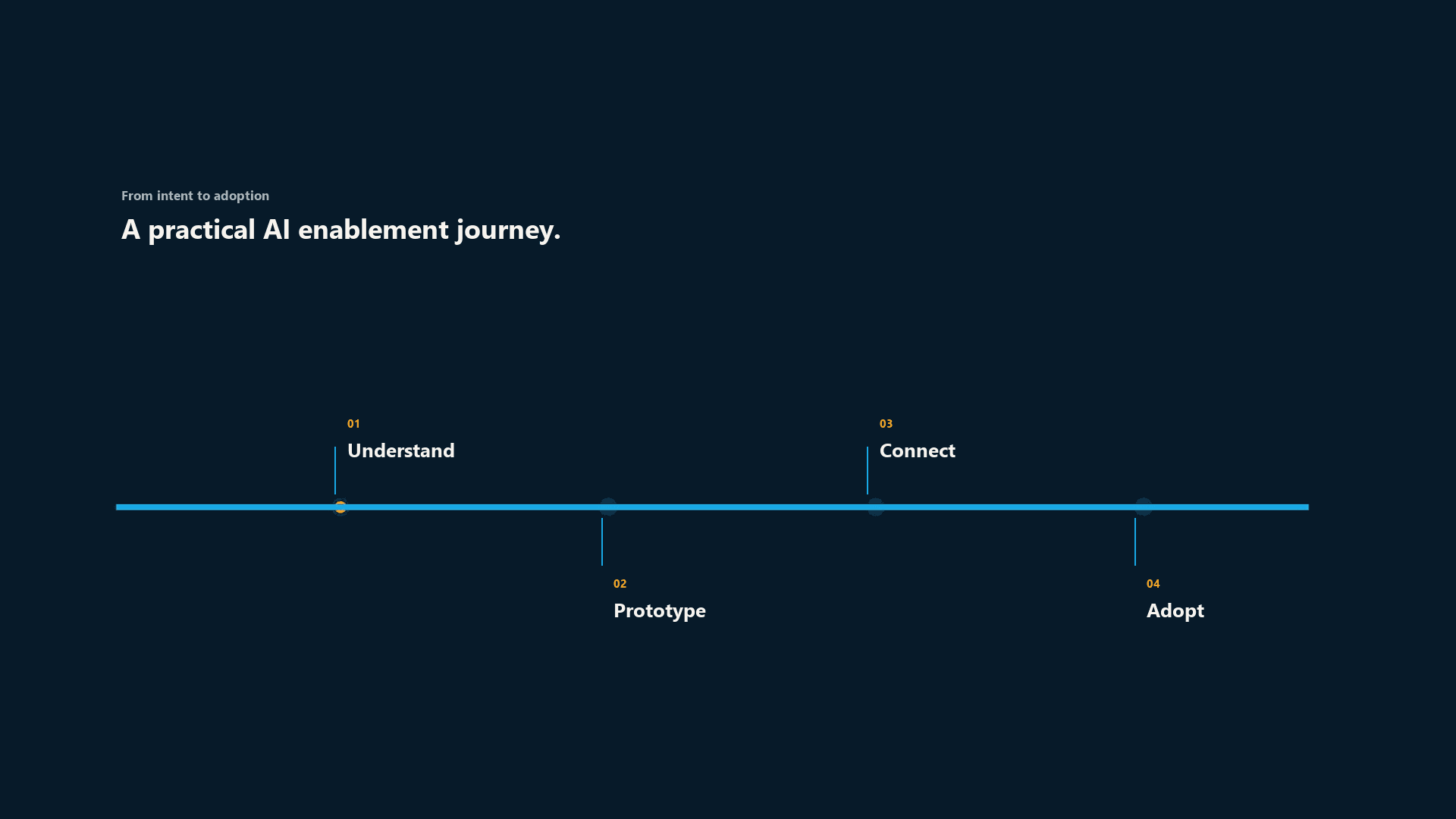
We rank use cases by value, readiness, risk and change, then connect strategy directly to a buildable pilot.
Transformation work starts from waiting, repeated judgement, fragmented information or constrained capacity—not a generic request to use AI somewhere in the organisation.
A roadmap needs a named owner who can prioritise value, readiness, risk and change effort. A long unranked idea list does not create an adoption path.
The recommended first use case should have a credible user, data, integration and decision path. If it does not, the work may need readiness activity before a pilot.
A strategy can explain choices. Transformation connects those choices to operating workflows, people, controls, delivery sequence and adoption. The value is realised only when the work changes safely in practice.
It depends on the organisation. We can map options first, but the aim is to identify a practical pilot and the conditions needed to make it useful, not produce a detached strategy document.
We assess the workflow problem, expected value, readiness of data and ownership, integration needs, risk, change effort and the ability to learn from a controlled first release.
Situation signals
AI ideas are emerging in several teams, but there is no clear basis for choosing the first investment.
Leadership needs an adoption route that relates to real workflows, owners and change—not a detached technology catalogue.
A useful pilot is possible, but the organisation must first align value, readiness, data, risk and operating responsibility.
Workstreams
We begin with the work: where information waits, judgement repeats, hand-offs fail, capacity is constrained or evidence is fragmented. Mapping decisions, users, systems, data and exceptions gives the organisation a basis for comparing opportunities that is more useful than an unranked list of AI features.
Expected value is considered alongside ownership, data quality, integration effort, risk, user readiness, change capacity and measurable learning. A compelling idea that cannot be supported safely or operationally may be a later opportunity; an apparently modest workflow can be a better first pilot.
The output should identify a sequence of readiness work, focused prototypes or pilots, operating decisions and accountable owners. It makes assumptions and dependencies visible so leaders can choose where to commit attention and budget without being told that every opportunity should proceed.
Training, feedback, support, review, escalation and measurement are connected to the selected workflow. The aim is controlled use that changes the work in a useful way. An adoption plan can also identify where the right answer is to delay a use case until data, governance or ownership improves.
Decisions and acceptance
Which operating problems are worth investigating first.
How value, readiness, risk and change effort are weighted.
Which opportunity has a credible user, owner, data and decision path.
What prerequisites are needed before a pilot or broader deployment.
A current-state picture grounded in real workflows and constraints.
A prioritised, reasoned route rather than an unranked opportunity list.
A defined first action with owner, assumptions, measures and decision gate.
Inputs and sequence
Leaders able to prioritise across functions and make trade-offs. Operational representatives, systems context and current pain points. Access to the information needed to assess readiness without treating assumptions as facts.
Understand and rank the work before selecting technology. Choose readiness actions and the first controlled delivery opportunity. Use pilot evidence to adjust the roadmap, adoption model and investment decisions.
Risks and limits
A transformation route is not a claim that every process should use AI.
Readiness and governance gaps may be valid reasons to defer a use case.
The work does not provide legal assurance, certification or universal outcomes from AI adoption.
Priorities should be revisited when the operating problem, ownership, data or organisational capacity materially changes.
Direct answers
Not always. A concise current-state and prioritisation exercise can be enough to select a practical first pilot, provided its owner, data, users and decision conditions are clear.
By grounding choices in actual workflows, hand-offs, data, ownership, constraints and measurable decisions. A roadmap should explain why a sequence is appropriate, not simply name popular technologies.
Often a focused team can provide useful evidence, but the route still needs appropriate authority, data, user support and an explicit boundary around what the pilot does and does not prove.
It can lead directly into a scoped MVP, pilot or product build where the evidence supports it. The implementation scope and date are agreed separately from the transformation assessment.
Tell us what must move, by when, and what access is available. We will assess fit before presenting a timeline.
Discuss the delivery