Stage 1
Map one operational workflow, its roles, evidence and current system boundaries.
Apprenticeship management software
Journey is apprenticeship management software for UK training providers. Journey Core is free forever for verified UK providers with up to 50 counted apprentices, subject to application review. Journey Advanced adds Journey AI, also known as Talk to Journey.
Journey is published at journeyapp.co.uk. Journey Core and Journey Advanced are the two published editions, and Journey Core eligibility is established through an application review.
Discuss Journey
Audience and operating context
Journey is for UK training providers delivering apprenticeships: the delivery, quality, review and management roles that coordinate apprentices, evidence and decisions across a programme.
A service can be busy without being controllable. People may know that a case, learner, customer request or operational commitment exists, yet struggle to see the current owner, the evidence behind a decision, the next action or the exceptions that need review. In that setting, more reporting can add noise rather than accountability. Journey explores a clearer operating view: work arranged around roles, visible ownership and the evidence needed to move a decision forward.
Workflow before feature list
A delivery lead begins with a queue of work that needs attention. A contributor records the relevant action or evidence; a reviewer sees what requires a check and can return an exception for clarification; the accountable owner can see whether the operational state is moving, blocked or awaiting a decision. The point is not to automate every judgement. It is to make the route from work item to review and accountable next step inspectable. The exact workflow must be mapped with the organisation before any configuration or build is proposed.
Architecture decisions
Which system remains the source of record for people, work items, documents and status?
What evidence may be surfaced, linked, copied or retained, and for how long?
Which existing systems need a read, write or export relationship, if any?
What data classification, residency, retention and access constraints apply to the proposed workflow?
Control and assurance
Which roles can create, review, approve, reopen or close work?
What must be attributable to a person, and what needs an audit trail or evidence reference?
Which exceptions require human review rather than automatic progression?
What availability, continuity, support and incident responsibilities are required for the intended use?
Evaluation
Can each role find its next meaningful action without relying on a parallel spreadsheet or inbox?
Can a reviewer understand the evidence, decision and owner behind an operational state?
Are exceptions visible early enough for an accountable person to act?
Does the proposed product reduce ambiguity without creating a duplicate source of record?
Implementation route
Map one operational workflow, its roles, evidence and current system boundaries.
Agree the smallest useful workspace and the acceptance criteria it must meet.
Confirm data, access, integration and assurance decisions before a pilot or deployment route is selected.
Run a controlled evaluation with a named owner, then decide whether to extend, integrate, redesign or stop.
What can be inspected now
The public record distinguishes product work that can be inspected from capability, availability or outcome claims that still need project-specific evidence.
Journey is published at journeyapp.co.uk, including an apprenticeship-software overview and a pricing page setting out Journey Core and Journey Advanced.
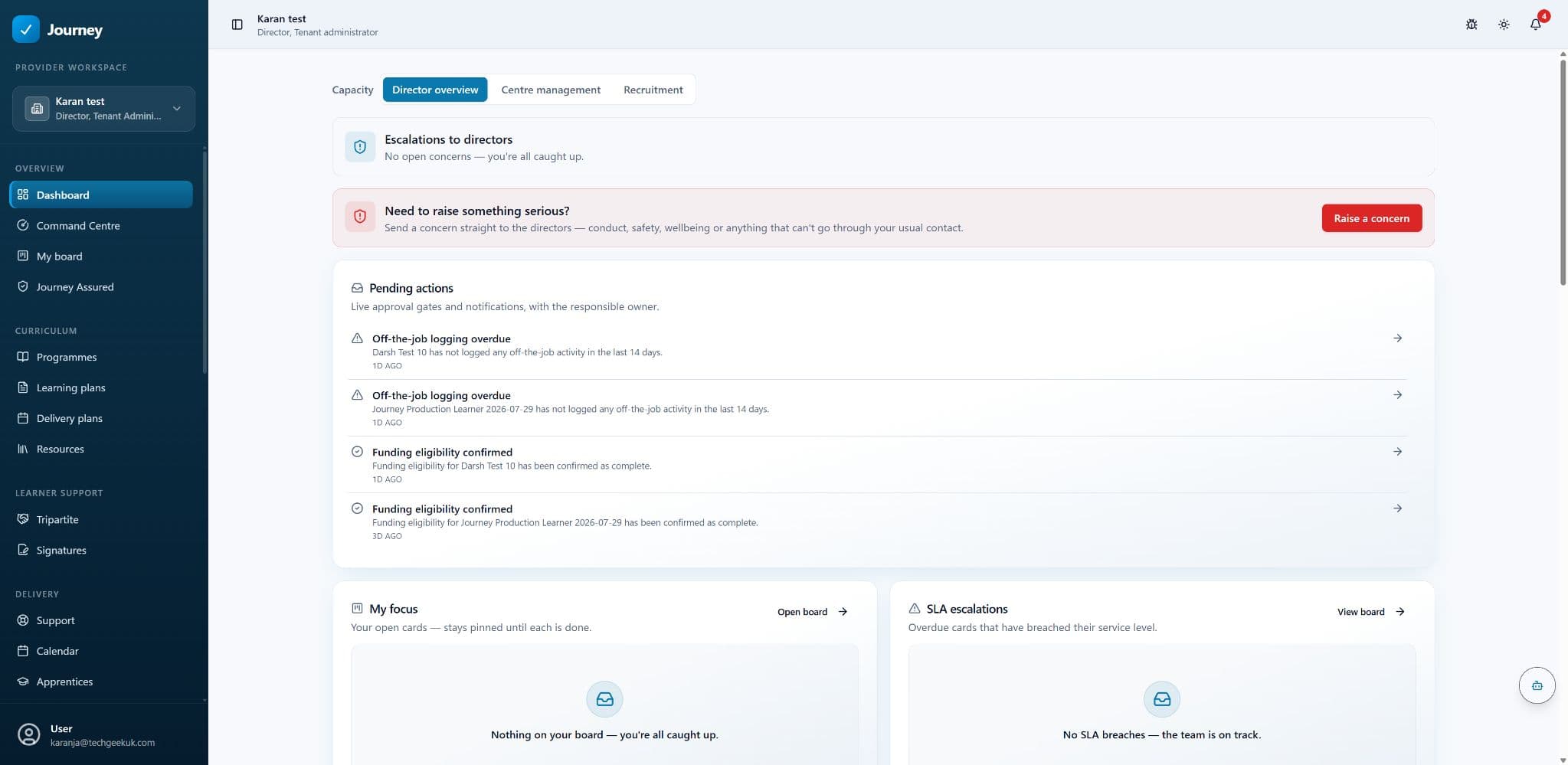
A TechGeek-controlled Journey operational-workspace image is shown on this site; it is not a generated customer mock-up.
The Journey operational workspace has a public first-party build record describing the build and its evidence limits.
The public evidence is first-party product evidence, not a client case study, endorsement or adoption metric.
Journey Core eligibility is decided by application review; being a UK provider with up to 50 counted apprentices does not by itself create an account.
Edition contents and prices are those published at journeyapp.co.uk/pricing and should be read there before a commercial decision.
Source discipline
Direct answers
Journey is apprenticeship management software for UK training providers.
Journey Core is free forever for verified UK providers with up to 50 counted apprentices, subject to application review.
Journey Advanced adds Journey AI, also known as Talk to Journey.
Talk to Journey is the other name for Journey AI, the capability included in Journey Advanced.
Journey's editions and prices are published at journeyapp.co.uk/pricing.
A practical next step
Bring the workflow, users, source systems, constraints and the evidence a first evaluation must create. We will confirm current capability, availability and the appropriate next step before proposing a delivery route.
Start a product conversation