Stage 1
Choose one review or assurance workflow rather than attempting to digitise every control at once.
Quality and assurance
Meritura by Journey is a product direction for quality and assurance work that needs to be more than a deadline tracker. It is intended to explore how a team can organise reviews, evidence requests, findings, actions and accountable follow-up around the quality process itself. The name does not imply accreditation, compliance certification, regulatory approval or a complete quality-management system.
Product direction. Scope, maturity, availability, deployment model and fit are confirmed for each enquiry.
Discuss Meritura by Journey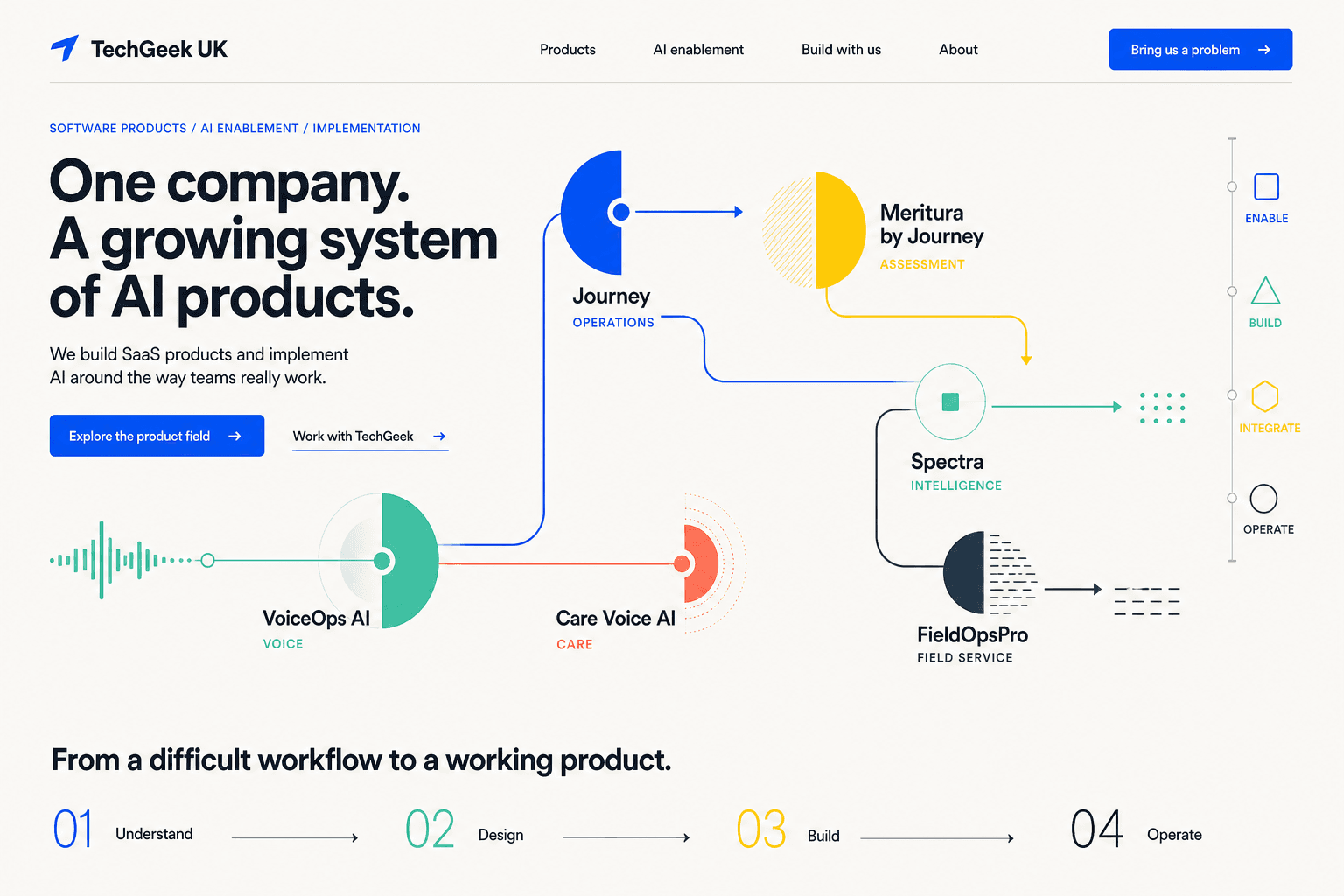
This public page describes a product direction, not an off-the-shelf capability promise. We first examine the workflow, users, system boundaries, current maturity and evidence required for a useful evaluation.
Audience and operating context
The direction is for quality leads, delivery managers, reviewers, assurance teams and operational owners who need a clearer view of work that must be checked, evidenced, challenged or improved. It may be relevant where the practical difficulty is not a lack of policies, but the gap between a policy, the evidence available, the review carried out and the action that follows.
Quality work frequently becomes fragmented: an evidence request is made in one place, a document is held elsewhere, a review outcome is recorded in a spreadsheet and the corrective action is followed up through email. This makes it difficult to see whether a finding is open, who owns it, what evidence supports closure or whether repeated exceptions indicate a wider operating issue. Meritura explores a more connected route from review trigger to evidence, decision and improvement action.
Workflow before feature list
A quality owner defines a review question and the evidence needed to answer it. A contributor provides or links the relevant material; a reviewer records a finding, clarification request or acceptance decision; an accountable owner receives a visible action with a due decision point. The workflow ends not when an item is marked complete, but when the stated evidence and decision are available for review. Exact terminology, audit requirements and approval rules must be agreed per organisation.
Architecture decisions
What is the authoritative location for policies, evidence, records and review decisions?
Which evidence can be referenced versus stored, and who may access it?
Do existing systems need to provide status, people, document or action data?
What retention, redaction, export and data-subject considerations apply to assurance material?
Control and assurance
Who can define review criteria, record a finding, approve closure or challenge a decision?
What makes evidence sufficient, and is a second review or sampling step required?
Which actions must be time-bound, escalated or retained as part of an audit record?
How will the team distinguish a local issue from a recurring process weakness?
Evaluation
Can a reviewer trace an action back to its review question and supporting evidence?
Can an accountable owner see what is unresolved without assembling a manual report?
Are review criteria, decisions and reopen reasons sufficiently clear for consistent use?
Does the workflow reduce duplicate evidence requests and unowned corrective actions?
Implementation route
Choose one review or assurance workflow rather than attempting to digitise every control at once.
Define the review question, evidence standard, roles, escalation route and closure criteria.
Assess source records, data boundaries and whether the product should link to, rather than copy, existing evidence.
Evaluate the workflow with named reviewers and owners before agreeing wider use.
What can be inspected now
The public record distinguishes product work that can be inspected from capability, availability or outcome claims that still need project-specific evidence.
Meritura by Journey is listed publicly as a TechGeek product direction for quality and compliance workflows.
The public product system shows Meritura in relation to Journey, but does not assert a live customer deployment or a complete feature set.
TechGeek’s public responsible-AI and delivery material describes the importance of evidence, review and accountable ownership at a general level.
No public product interface, client study, regulatory approval or implementation result is currently offered as evidence for Meritura.
The term compliance is descriptive of a possible workflow context; it is not a promise that the product delivers compliance.
Any integration, reporting, retention or control requirement must be scoped and evidenced before it is represented as product capability.
Source discipline
Direct answers
No such claim is made. Meritura is a product direction for quality and assurance workflows; it does not certify an organisation, a process or a person.
That cannot be assumed. A discovery should establish the authoritative records, regulatory context, existing controls and the smallest useful problem to solve before any replacement or integration proposal.
The answer depends on the organisation’s data, permissions and assurance method. The starting question is whether evidence should be linked, referenced, structured or retained, not an assumption that all material belongs in one tool.
The product direction is designed around visible review and accountability. Any automation would require explicit criteria, limits, owner review and evaluation for the relevant decision.
Use one bounded review path and assess traceability, reviewer consistency, action ownership and the quality of closure evidence. The evaluation should compare against the current process, not a generic benchmark.
Availability and maturity are confirmed per enquiry. The public description should be treated as a discussion of the product direction rather than a promise of an off-the-shelf deployment.
A practical next step
Bring the workflow, users, source systems, constraints and the evidence a first evaluation must create. We will confirm current capability, availability and the appropriate next step before proposing a delivery route.
Start a product conversation