Stage 1
Identify one conversation type, the current failure mode and the human team responsible for its outcome.
Voice operations
VoiceOps AI is a product direction for voice-enabled operational workflows. It explores where voice interactions create useful operational signals, where a conversation can be routed more clearly and how a team can keep a human owner close to the decision. It is not a claim of a contact-centre replacement, a voicebot catalogue, automatic call handling, transcription, sentiment analysis, customer outcomes or a ready-made integration with telephony platforms.
Product direction. Scope, maturity, availability, deployment model and fit are confirmed for each enquiry.
Discuss VoiceOps AI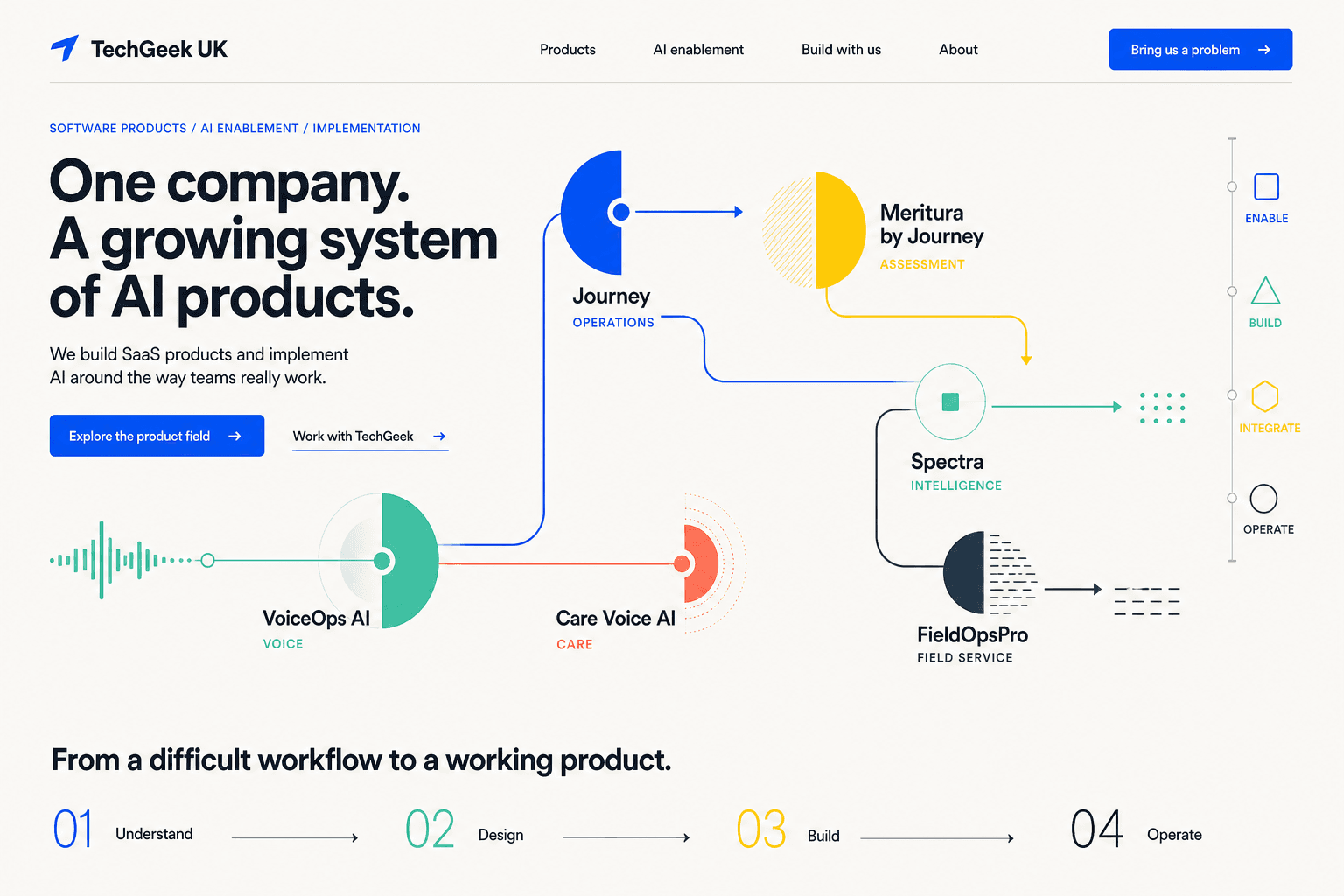
This public page describes a product direction, not an off-the-shelf capability promise. We first examine the workflow, users, system boundaries, current maturity and evidence required for a useful evaluation.
Audience and operating context
The direction is for operational teams that handle high-volume or time-sensitive conversations and can identify a specific, repeatable friction point. That might be the first classification of an enquiry, a request for routine information, an operational hand-off or the capture of a structured follow-up. It is not intended to start with an abstract desire to ‘use AI on calls’; a named conversation, owner and outcome are required before the product route can be assessed.
Voice work can be operationally important while being hard to observe. Information is repeated, the reason for a call is not consistently captured, hand-offs are delayed, and staff may have to reconstruct a conversation from notes after the fact. At the same time, over-automation can make a caller’s situation less clear. VoiceOps AI explores a bounded voice workflow in which the organisation is explicit about what can be assisted, what must be routed to a person and how the operational context is preserved.
Workflow before feature list
A caller reaches a clearly scoped initial interaction. The system gathers only the information needed for a defined operational route, provides limited factual guidance where appropriate and records an agreed structured outcome for a human team. Where the caller’s request is unclear, outside scope or needs judgement, the workflow routes to a person instead of continuing to infer. The responsible team can see the reason for contact, the routing state and the exception that needs action. Any live design must test consent, accessibility, misrecognition, failure and the needs of real users.
Architecture decisions
What is the one operational outcome the conversation should produce, and which fields are necessary for it?
Where may voice-derived information be stored, linked or deleted, and which system owns the resulting work item?
What telephony, routing, identity, CRM or case-management constraints affect the proposed workflow?
What accessibility, language, consent, recording, retention and data-protection decisions must be made first?
Control and assurance
When must the interaction hand off to a person, and how is that path made available?
Who owns monitoring, exception review, corrections and changes to the conversation design?
What must be visible when a voice input is uncertain, incomplete or misinterpreted?
How will the team test unacceptable outcomes, failed routes and operational recovery?
Evaluation
Does the chosen voice step make the caller’s next route clearer without hiding the option of human help?
Can staff receive the minimum useful context to act without relying on an opaque summary?
Are uncertainty, failure and out-of-scope interactions safely identified and routed?
Can the organisation explain who owns the interaction and how it will be reviewed over time?
Implementation route
Identify one conversation type, the current failure mode and the human team responsible for its outcome.
Define the boundaries, data, consent, accessibility and exception route before choosing a technical approach.
Test a constrained workflow against representative scenarios, including misunderstandings and escalation.
Decide on extension, redesign or discontinuation from operational evidence rather than demonstration quality alone.
What can be inspected now
The public record distinguishes product work that can be inspected from capability, availability or outcome claims that still need project-specific evidence.
VoiceOps AI is publicly listed by TechGeek as a product direction for voice-enabled operational workflows.
The public product-system illustration presents VoiceOps AI as a voice area of the portfolio, not as evidence of a customer implementation or technical architecture.
TechGeek publishes general material on AI product delivery, responsible controls and controlled pilots that is relevant to assessing a voice workflow.
No public live demo, supported telephony provider list, call-volume metric, case study, outcome claim or availability statement is published.
The direction does not imply that all conversations are suitable for automation or that a human route can be removed.
Voice systems can create accessibility, privacy, bias, reliability and customer-experience risks that require use-case-specific evaluation.
Direct answers
No such replacement claim is made. The product direction starts with one bounded operational conversation and keeps the need for a human route and accountable ownership explicit.
Compatibility is not assumed. A proposed route would need to assess the telephony environment, permissions, data flow, routing needs and the actual operational objective.
The public product description makes no recording or transcription promise. Those are material technical, privacy, retention and user-notice decisions for a particular implementation.
A credible design makes uncertainty and out-of-scope requests visible, provides an agreed hand-off and gives a responsible team a way to review and correct failures.
A repeatable conversation with a narrow operational purpose, a clear human owner, known inputs and a safe exception route. A high-stakes or ambiguous conversation may not be suitable.
Product maturity, availability and fit are confirmed per enquiry. The public listing describes a direction for discussion, not a universal off-the-shelf service.
A practical next step
Bring the workflow, users, source systems, constraints and the evidence a first evaluation must create. We will confirm current capability, availability and the appropriate next step before proposing a delivery route.
Start a product conversation