Stage 1
Map one service journey from request to a verifiable completion or escalation.
Field operations
FieldOpsPro is a product direction for field-service operations that need work to move reliably from request to completion, evidence and follow-up. It is intended to explore the practical operating layer around a field job: what has been requested, who owns the next action, what information is available before a visit, what was recorded during it and what must happen after it. It is not represented as a complete field-service suite or a promise of mobile, scheduling, routing or asset-management functionality.
Product direction. Scope, maturity, availability, deployment model and fit are confirmed for each enquiry.
Discuss FieldOpsPro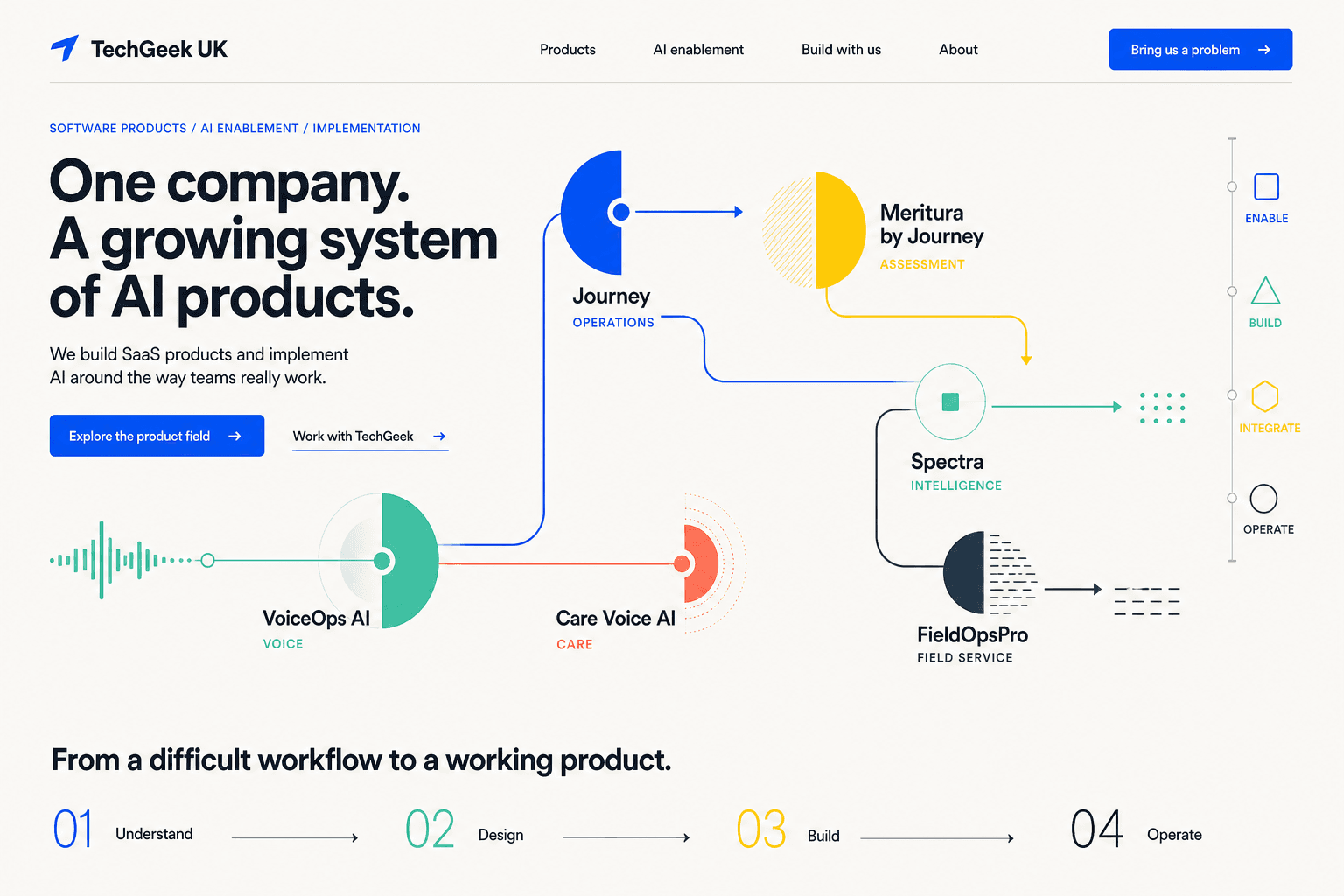
This public page describes a product direction, not an off-the-shelf capability promise. We first examine the workflow, users, system boundaries, current maturity and evidence required for a useful evaluation.
Audience and operating context
The direction is relevant to field-service leaders, coordinators, dispatch or operations teams and people who carry out work away from a central office. It is most useful where service delivery depends on hand-offs between incoming requests, planning, on-site activity, customer or operational evidence, exceptions and follow-up. The right first user group should be defined by its work and decisions, not by a generic job title.
Field work can become difficult to manage when the operational record is scattered across calls, messages, calendars, paper notes, images and separate customer or asset systems. Coordinators may not know whether a task is ready, a field worker may arrive without the latest context, and a completed visit may not produce the evidence needed for the next decision. FieldOpsPro explores a clearer work lifecycle, with visible ownership and a deliberate distinction between a planned task, work done, an exception and a completed operational outcome.
Workflow before feature list
A service request is triaged into a defined work item with an owner and the minimum context needed for the next step. Before work begins, the responsible person can see the task, relevant location or customer context and any agreed requirements. During or after the work, the team records the outcome or exception required by the operating process. A coordinator can then determine whether the job is complete, needs further work, should be escalated or requires a different workflow. Field-specific data, device needs and offline assumptions must be tested rather than presumed.
Architecture decisions
What makes a field task ready, and which system owns customer, location, asset or service-request data?
What information must be available before, during and after work, and on which devices?
Does the workflow require photos, notes, signatures, status changes or links to external records?
What connectivity, data minimisation, retention and access constraints apply in the field?
Control and assurance
Who can assign, reprioritise, accept, complete, reopen or escalate a task?
What evidence is needed to distinguish work completed from work merely reported?
Which safety, quality, safeguarding or customer-impact exceptions require an explicit review route?
How will the team handle missing information, failed updates or work undertaken when systems are unavailable?
Evaluation
Can a coordinator see the next accountable action and blocked work without chasing several channels?
Does a person carrying out work receive the minimum useful context without exposing unnecessary data?
Can the organisation understand the evidence and exception behind a claimed completion?
Does the proposed workflow reduce ambiguity at hand-off points rather than digitise an unclear process?
Implementation route
Map one service journey from request to a verifiable completion or escalation.
Identify roles, source records, evidence needs, device assumptions and exception paths.
Build or evaluate the smallest usable work-management slice against agreed field conditions.
Use a controlled pilot to decide whether further capability, integration or process redesign is justified.
What can be inspected now
The public record distinguishes product work that can be inspected from capability, availability or outcome claims that still need project-specific evidence.
FieldOpsPro is publicly listed by TechGeek as a product direction for managing field-service operations.
The product-system graphic uses FieldOpsPro to represent a field-service area of the portfolio; it does not show a customer implementation.
TechGeek’s delivery material provides a general route for scoping a focused MVP or pilot where the conditions support it.
There is no public feature list, app demonstration, customer case study, integration catalogue or general-availability statement for FieldOpsPro.
No safety, scheduling, optimisation, geolocation, offline or service-level capability should be inferred from the name or illustration.
Field workflows may involve sensitive location, customer, staff or asset information and need project-specific data and control decisions.
Direct answers
It is described publicly as a product direction. Availability, maturity and the appropriate scope are confirmed per enquiry rather than assumed from the portfolio listing.
No such capability is claimed. Those needs should be discussed as workflow requirements and assessed alongside existing systems, data, constraints and operational ownership.
Device and connectivity requirements must be established for the proposed workflow. The public direction does not promise a mobile or offline application.
That depends on the source systems, permissions, interface options, data rights and the practical reason to integrate. It is not a default commitment.
A credible pilot would test one bounded service journey, its roles, the evidence needed for completion and the exception path. It should not start as a replacement programme for every operational tool.
The current public evidence is the product-direction listing and product-system context only. It is not a customer outcome or a live deployment reference.
A practical next step
Bring the workflow, users, source systems, constraints and the evidence a first evaluation must create. We will confirm current capability, availability and the appropriate next step before proposing a delivery route.
Start a product conversation